Dental Implants.
Replacing teeth, the way nature intended.
Missing teeth shouldn't hold you back from eating, smiling, or living with confidence. At Leichhardt Dental, dental implantology is the primary focus of our clinical practice. Led by Dr Nick Kulkarni — a registered specialist prosthodontist with over 25 years of extensive international clinical experience and a Fellow of the International Congress of Oral Implantologists — we combine world-class 3D imaging with advanced surgical techniques to restore your smile's permanent strength. We achieve predictable, long-term results by focusing on three strict pillars of care: unrivalled accuracy with in-house 3D CBCT imaging; 100% synthetic bone regeneration with EthOss (no donor or animal tissue); and premium Zirconia crowns, 100% made in Sydney by master technicians — we do not outsource our restorations to cheap overseas labs. We also offer metal-free zirconia implants for patients who prefer a non-metal option. Flexible payment plans are available through TLC Finance.
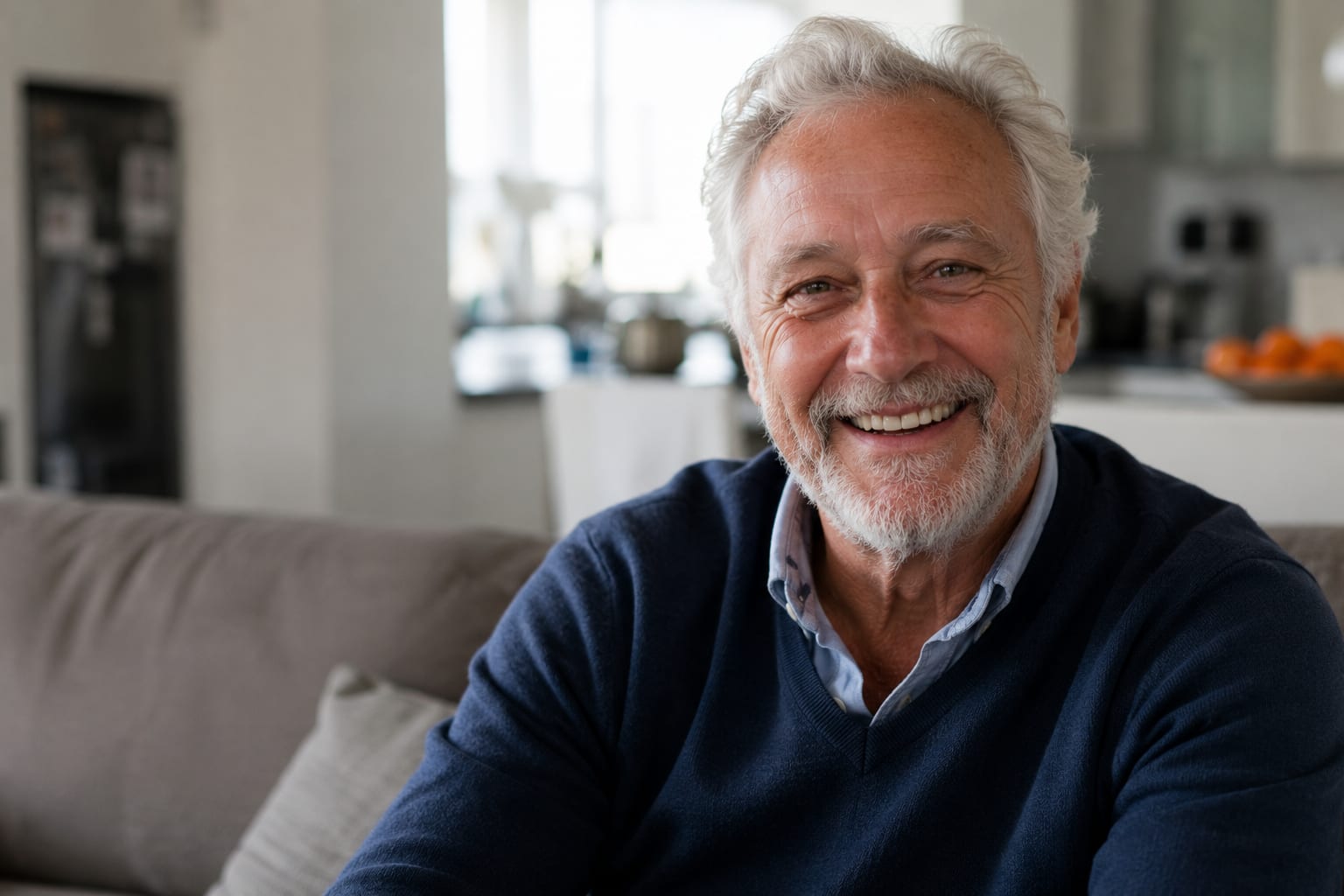
Led by a specialist prosthodontist.
Your implant treatment is planned and placed by Dr. Nick Kulkarni — a registered specialist prosthodontist with over 25 years of international clinical experience, who also trains other dentists in implant surgery and IV sedation.
- Registered specialist prosthodontist (Dental Board of Australia)
- Master's in Prosthodontics — I.P. Pavlov University
- Graduate Diploma in Oral Implants — University of Sydney
- Fellow, International Congress of Oral Implantologists (ICOI)
- Advanced training — Misch Implant Institute (Florida) & Walpole Institute (London)
- Founder & director, Place Your First Implant — live-patient implant & IV-sedation training for dentists
From a single tooth to a full arch.
 01
01Single Tooth Implants
A titanium post placed where the tooth root used to be, topped with a zirconia crown made locally in Sydney. Teeth either side are left untouched — unlike a bridge.
 02
02Zirconia (Metal-Free) Implants
At Leichhardt Dental Centre, we offer advanced zirconia implant solutions for patients seeking durable, highly aesthetic, and completely metal-free options to restore missing teeth. We use the Straumann® Pure Ceramic system.
 03
03Implant-Supported Overdentures
A denture that snaps onto two or more implants rather than resting on the gums. Far more stable than a conventional denture; still removable for daily cleaning.
 04
04All-on-4 Implants
A fixed full arch of teeth supported by four or more implants per jaw. For patients missing most or all of their teeth, or whose current teeth cannot be saved.
Data-driven, evidence-based, precise.
Three principles guide every implant case we plan — careful imaging, biologically sound materials, and local craftsmanship.
3D CBCT imaging
Every implant patient has an in-house 3D CBCT scan. Where flat 2D X-rays can miss detail, the 3D scan maps your jaw in high definition — so we can measure bone depth and density to the millimetre, map nerve pathways and sinuses to plan a precise, safe surgical path, and position your implant virtually before the procedure begins.
EthOss synthetic bone grafting
If your scan shows a graft is needed, we use EthOss — a synthetic, medical-grade biomaterial — rather than animal- or donor-derived bone. Made entirely in the lab, it removes the cross-infection risk that comes with donor tissue, contains no animal products (vegan-friendly), and acts as a temporary scaffold your body turns over into its own bone over a few months.
Locally made zirconia crowns
Every restoration is finished with a custom-milled zirconia crown, designed and crafted locally in Sydney rather than outsourced overseas. Zirconia is a tough, fracture-resistant ceramic that holds its appearance and stands up to everyday chewing forces.
Our 3D CBCT scans are clinical files used for internal surgical planning only and are not available for external download.
How an implant is placed.
- Step 01
Consultation & 3D imaging
Dr. Nick reviews your medical and dental history and takes a low-dose 3D CT scan. This lets us see the bone volume, nerve position, and exact space available — no guesswork.
- Step 02
Digital surgical planning
Using the CT data, we plan the implant position on screen before touching a scalpel. Safer, more predictable, and more precise than conventional planning.
- Step 03
Implant placement
A minor surgical procedure, usually under local anaesthetic. For larger cases like All-on-4, sedation or general anaesthesia is available. You go home the same day.
- Step 04
Osseointegration (healing)
Over the next 3–6 months, the titanium implant fuses with your jawbone. This bond is what gives the final tooth its strength. A temporary tooth or bridge can often be worn during this phase.
- Step 05
Final restoration
Once the implant is fully integrated, we take a digital impression and fit your permanent crown, bridge, or fixed arch — matched in shape and shade to your other teeth.
The All-on-4 journey.
- Step 01
Consultation & 3D CT imaging
A full assessment of your bone, bite, and medical history. The CT scan determines whether All-on-4 is the right option for you.
- Step 02
Digital smile & surgical planning
We design the final set of teeth digitally, then plan the four implant positions around that design — not the other way round.
- Step 03
Implant surgery
Four implants placed per arch in a single surgical visit, typically under sedation or GA for comfort. Any remaining compromised teeth are removed at the same time.
- Step 04
Same-day provisional teeth
A fixed set of temporary teeth is attached to the implants on the day of surgery. You leave the practice with a full set of teeth — not dentures, not gaps.
- Step 05
Healing period
3–6 months for the implants to bond with bone. You wear the provisional teeth, eat progressively firmer foods, and return for routine reviews.
- Step 06
Final prosthesis
Once healed, the provisional is replaced with your final fixed prosthesis — crafted for longevity, aesthetics, and function. Regular maintenance visits keep it in good order.
Risks & considerations
Dental implant surgery is generally safe and well-established, but carries risks including infection, bleeding, swelling, transient nerve sensitivity, sinus involvement in the upper jaw, and — rarely — implant failure where osseointegration does not occur. Long-term success depends on oral hygiene, general health, and regular maintenance visits.
All dental procedures carry potential risks and benefits. Individual results vary. A consultation with a registered dental practitioner is required to determine whether a treatment is suitable for you.
Common questions about implants.
Thinking about an implant?
The first step is a consultation and 3D scan — so we can tell you honestly what's possible in your case.
Book an appointment online